
Template & Guide
How to write a capability statement [Free templates]
Rob Nathan, Founder and CEO · Updated November 2026 · 8 min read

ON THIS PAGE
When Buyers ask for one
When do Buyers ask for a capability statement
Think of a capability statement as a resume for your business. It gives Buyers a concise overview of your services, experience, qualifications and ability to deliver.
You'll commonly need one when:
-
Responding to an expression of interest (EOI) or tender.
-
Applying to join a Supplier panel.
- Registering on supplier portals for major project supply chains.
- Pitching to prospective B2B clients or meeting Buyers and prime contractors at industry briefings.
Capability statements are widely used across Australian industries, particularly construction, mining, energy, infrastructure, engineering, transport and commercial services.
Ultimately, Buyers want to know three things: can your business do the work, have you delivered similar projects before, and do you meet their requirements?
What to include in a capability statement
A capability statement for a tender usually fits on one page, built from four sections. Our guide covers each one in detail, and the example shows how a finished, designed version can look.
| 01 |
Business overview
One or two sentences on what you do, who you work for and where. Before you write it, work out what matters most to your clients (delivery on time, staying within budget, availability) and lead with that. Include ABN, years operating and the areas you service nearby.
|
| 02 |
Core competencies
A bullet list of your services, skills, specialist capabilities and service levels. Use the words buyers use in their tender documents. If safety, quality or innovation is a real strength, say so here.
|
| 03 |
Past performance
Recent projects, most relevant first, showing how you overcame challenges or exceeded expectations. Use numbers where you can, and keep a second version if you work in two different markets. See writing case studies for tenders.
|
| 04 |
Differentiators
What makes a Buyer choose you over a competitor with similar experience: your location, equipment, team size, responsiveness, capacity, or something you offer that others don't. Back each claim with evidence. Our guide to presenting your value shows how.
|
| 05 |
Certifications, policies and insurances
Licences, ISO certifications, WHS and quality policies, Indigenous business certification where it applies, and current insurance cover.
|
| 06 | Business details
ABN, years operating, number of staff, locations and service areas. Add industry or UNSPSC codes if buyers in your sector use them.
|
| 07 |
Contact details |
Example capability statements
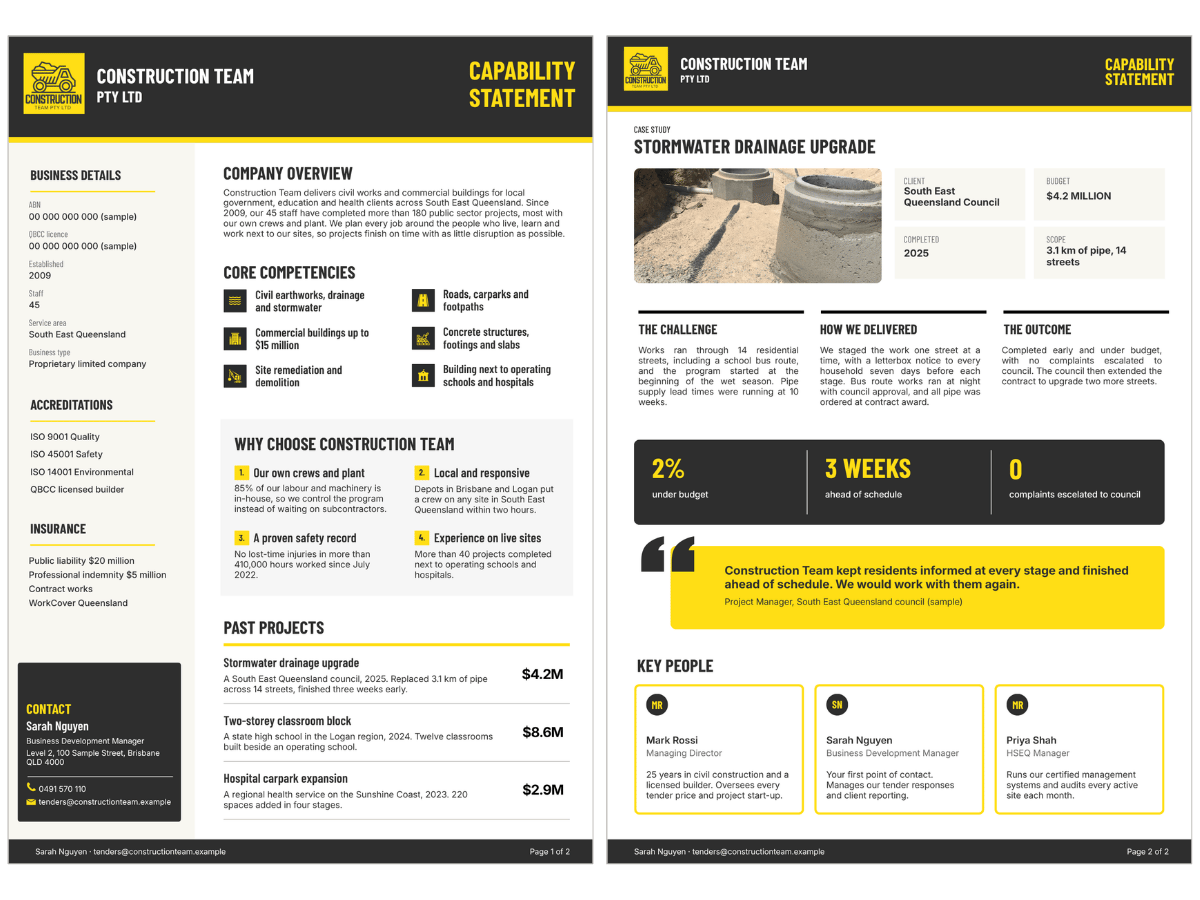
We've made two examples for the same fictional business, Construction Team Pty Ltd, so you can see how the length changes with the job. Every name, figure and client in them is invented.
Two-page examples
Best used for: tender submissions, expressions of interest, supplier panel applications and portal registrations, where buyers want the facts quickly and may set a page limit.
download the PDF example and editable template
2-page example 2:
download the PDF example and editable template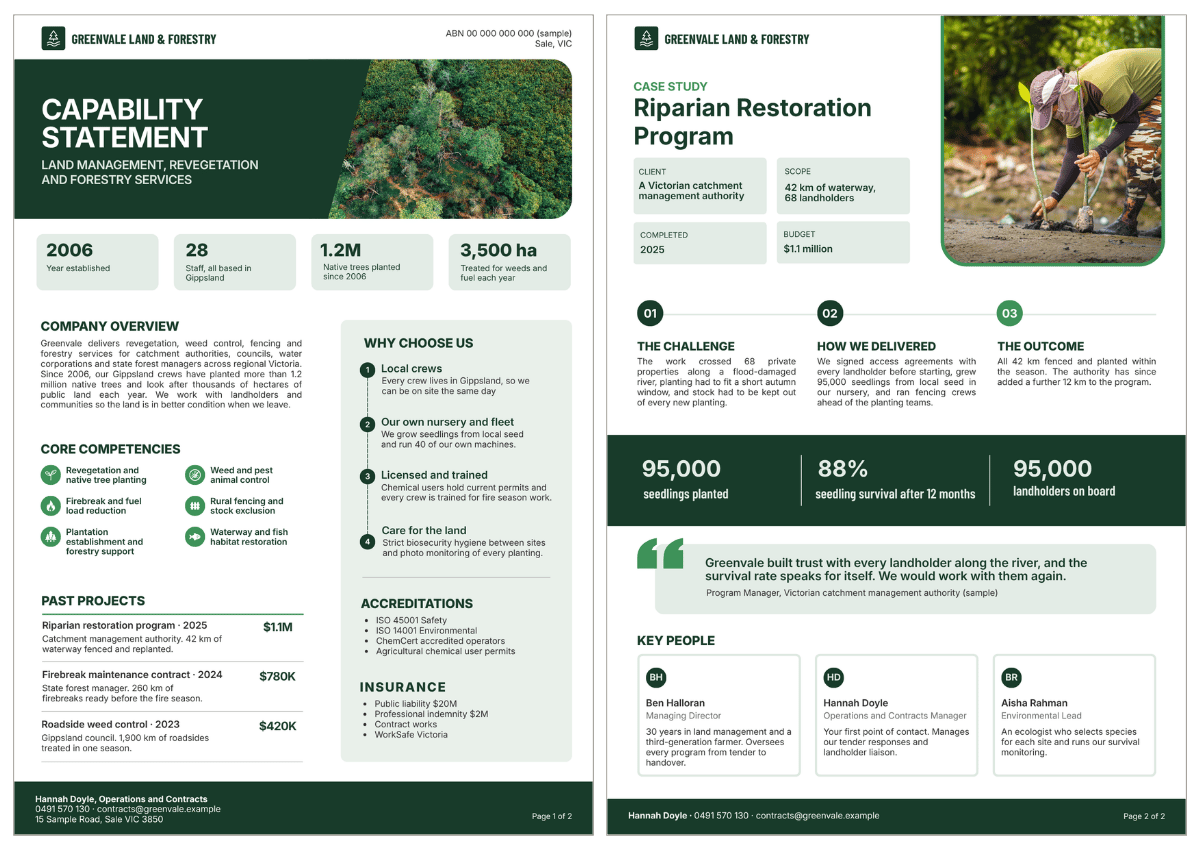
Six-page example
Best used for: company packs, client meetings, industry briefings and business-to-business pitches, where you have more room to show your work, your people and your brand.
Click to enlarge pages or download the full PDF.
How long should a capability statement be?
As long as the Buyer needs and no longer, usually one to two pages. If a tender sets a page limit, follow it exactly.
Tailoring it to a tender
A general capability statement is fine for networking, but a tender deserves a tailored version. Read the buyer's tender documents first, then:
-
Reorder your services so the ones the buyer needs come first
-
Choose past projects of a similar size, sector and location
-
Use the Buyer's own terms for the work and the outcomes they want
-
Check every insurance and certification the tender lists as mandatory is shown
Top five most common mistakes
| 01 |
Claims without evidence
"High quality" and "customer focused" tell a buyer nothing. A completion date, a client name or a measured result does.
|
| 02 |
Listing everything you have ever done
Pick the work that matches the buyer. A long list hides your strongest projects.
|
| 03 |
Out-of-date details
Expired insurance, old staff names or a disconnected phone number undermine everything else on the page.
|
| 04 |
Stock photos of someone else's work
Buyers recognise them. Use photos of your own sites and team where you can.
|
| 05 |
No named contact
Buyers want to know who to call. Give them a person, not a general inbox.
|
Put your capability statement to work
Find tenders that match what you deliver, with same-day alerts from more than 4,000 sources across Australia and New Zealand.
Frequently asked questions
-
How long should a capability statement be? addremove
One page for most tenders, plus an optional second page, unless the Buyer sets a limit. A longer designed version works well for briefings and meetings.
-
Is a capability statement the same as a company profile? addremove
No. A company profile describes the whole business. A capability statement is shorter and focuses on the work you can deliver for a particular type of Buyer.
-
Do I need a different one for every tender? addremove
Keep one master version, then tailor the summary, competencies and projects for each tender. Once the master is right, this usually takes under an hour.
-
What if my business is new and has no past projects? addremove
Use the relevant experience of your key people, private sector work and any subcontract work you have done. Say clearly whose experience it is.
-
What file format should I send? addremove
A PDF, unless the Buyer asks for another format.